
Search remains one of the most profitable growth channels in digital marketing. But how people search and how answers are delivered has fundamentally changed.
Google is no longer the only starting point.
Today, decision-makers increasingly ask AI tools like ChatGPT, Google Gemini, Perplexity and Microsoft Copilot questions such as:
- “What’s the best B2B CRM for mid-sized SaaS companies?”
- “Which e-commerce platforms scale best in Europe?”
- “What agency should we use for SEO and AI visibility?”
Instead of ten blue links they receive one synthesized answer.
If your brand is part of that answer, the business impact can be significant. If it isn’t, traditional SEO alone won’t protect your visibility. This shift is why Answer Engine Optimization (AEO) and Generative Engine Optimization (GEO) are quickly becoming core growth channels not experimental tactics.
From SEO to GEO and AEO: Why search has entered a new era
Traditional SEO (Search Engine Optimization) focuses on ranking web pages in search engines like Google. The classic model looks like this: Visibility → Clicks → Conversions. That model still works but it’s no longer complete.
AI-powered systems don’t rank a single page. They retrieve information from multiple sources, evaluate entity authority, and generate a conversational response. In many cases, users never see a traditional search results page at all. This evolution has introduced two new optimization layers:
- AEO (Answer Engine Optimization)
Optimizing your brand so AI tools present you as the answer to specific questions. - GEO (Generative Engine Optimization)
Optimizing how your brand and content are represented, framed, and described in AI-generated outputs.
In simple terms:
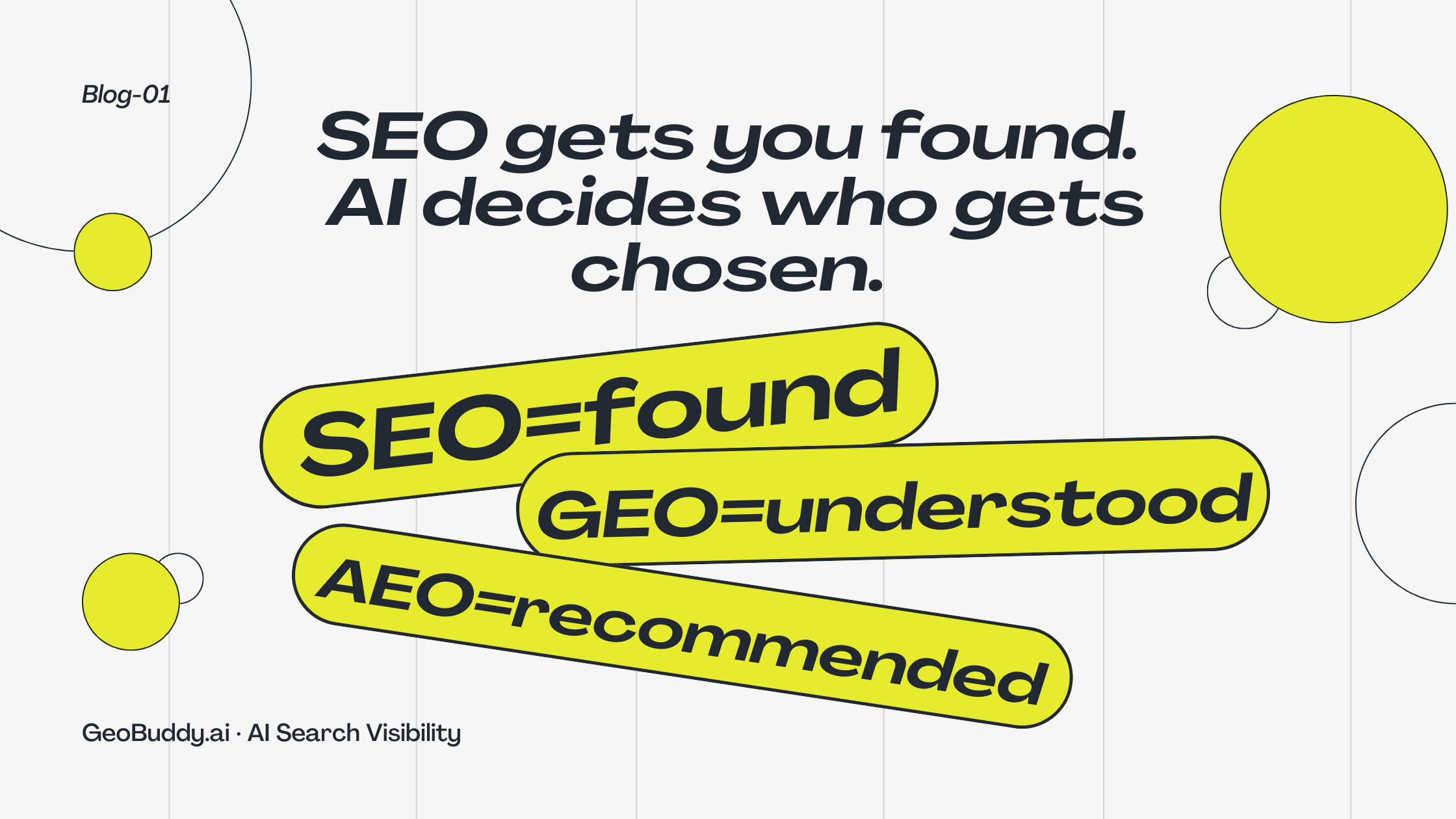
- SEO helps you get clicked.
- AEO and GEO help you get recommended.
And recommendations convert.
Quick Glossary (for readers new to the space)
Answer Engine
An AI system that generates direct answers instead of lists of links (e.g. ChatGPT, Gemini).
Retrieval-Augmented Generation (RAG)
A process where AI retrieves real external content before generating an answer.
Entity
A clearly defined concept (company, product, person) that AI systems can recognize and connect across sources.
What Is AEO (Answer Engine Optimization)?
Answer Engine Optimization (AEO) is the practice of optimizing your content, brand mentions, and digital footprint so AI systems present your business as a direct answer to user questions. Unlike traditional SEO, AEO is not about ranking a single URL at position #1.
AEO focuses on:
- Being cited across multiple trusted sources
- Being recognized as a relevant, authoritative entity
- Appearing consistently in AI-generated summaries
Why this works today
Modern AI tools rely on retrieval-augmented generation (RAG) — meaning they pull from real content (blogs, forums, documentation, videos) and summarize it in real time. If your brand is clear, credible, and well-referenced, it can be surfaced even without owning a top Google ranking.
What Is GEO (Generative Engine Optimization)?
Generative Engine Optimization (GEO) is a broader discipline that focuses on how AI systems:
- Understand your brand
- Describe what you do
- Position you relative to competitors
- Frame your strengths and use cases
While AEO emphasizes being the answer, GEO focuses on how the answer is shaped.
In practice, GEO looks at:
- Brand positioning inside AI responses
- Consistency of messaging across sources
- Accuracy of product or service descriptions
- Whether you’re mentioned alongside competitors — or excluded entirely
AEO and GEO overlap heavily, but together they form the foundation of AI-driven discovery visibility.
Why GEO and AEO Matter for Revenue (Not Just Visibility)
This isn’t theoretical. Early industry data and client observations show that AI-driven referral traffic often converts better than traditional organic traffic.
Why?
-
Higher intent
Users arrive after asking multiple follow-up questions. They’ve already narrowed their options. -
Built-in trust
Being presented as the answer carries more authority than being a ranked link. -
Reduced competition
Instead of ten competitors on a page, AI answers may mention only a few brands — sometimes just one.
For B2B, SaaS, and high-consideration e-commerce, this often results in:
- Higher-quality leads
- Shorter sales cycles
- Better conversion rates per visitor
This is why brands that consistently appear in AI answers often see outsized ROI compared to SEO alone.
How AEO Differs From Traditional SEO (And Why It Matters)
Although AEO builds on SEO fundamentals, several differences are critical.
-
Rankings matter less than frequency
In classic search, ranking first can win the click. In AI summaries, being mentioned across multiple trusted sources matters more than owning a single position.
-
The long tail is dramatically larger
AI conversations naturally expand through:
- Follow-up questions
- Comparisons
- Edge cases
- Implementation details
This increases the value of deep, topic-based content, not just keyword-targeted pages.
-
Speed favors agile brands
You don’t need years of domain authority to appear in AI answers.
A relevant:
- Reddit discussion
- YouTube video
- Niche blog post
- Help article
…can be cited almost immediately — something far harder to achieve with traditional SEO.
How AI Systems Decide What (and Who) to Cite
AI systems don’t “think.” They retrieve, evaluate, and summarize.
Factors that consistently influence citations include:
- Clear topical relevance
- Repeated mentions across independent sources
- Trusted platforms (blogs, forums, documentation, videos)
- Content that directly answers real questions
This is why off-site presence now matters as much as on-site optimization.
A Practical AEO & GEO Playbook
-
Start with real business questions
Use inputs from:
- Sales calls
- Support tickets
- Paid search data
- Community forums
These questions often map directly to AI prompts.
-
Build topic hubs — not just landing pages
Effective content:
- Covers a topic end-to-end
- Anticipates follow-ups
- Connects related subtopics
This dramatically increases citation probability.
-
Treat help content as a growth asset
Help centers often contain exact user phrasing used in AI chats.
Best practices:
- Keep help content on your main domain
- Interlink it clearly
- Expand it with real examples
-
Invest in off-site mentions AI trusts
AI systems frequently cite:
- Reddit and community forums
- YouTube explainers
- Expert blogs
- Comparison articles
Authentic contributions outperform spam every time.
-
Measure “share of answer”
AEO success isn’t binary. Track:
- How often you’re mentioned
- Where you appear in summaries
- How consistently your brand shows up
This is the AI equivalent of keyword rankings.
Why Human-Led, AI-Assisted Content Wins
AI can accelerate content production — but fully automated content rarely performs well long-term.
The winning model:
- AI for structure and efficiency
- Humans for insight, originality, and expertise
Original viewpoints, real examples, and clear explanations are exactly what both search engines and answer engines reward.
SEO, GEO, and AEO Work Best Together
This is not about replacing SEO.
It’s about stacking channels:
- SEO builds authority and discoverability
- AEO earns recommendations
- GEO shapes how your brand is perceived in AI-generated answers
Together, they create compounding visibility — especially as AI becomes a primary discovery layer.
Real-World Examples: How GEO & AEO Show Up in Practice
Example 1 — B2B SaaS
A SaaS company ranking #3 for “best CRM for SaaS” wasn’t mentioned in AI answers. After publishing comparison content, clarifying positioning, and earning off-site mentions, the brand began appearing consistently in AI-generated recommendations — without ranking #1.
Takeaway: AI values contextual clarity, not just rank.
Example 2 — Ecommerce
An ecommerce brand with strong SEO traffic struggled with returns. Adding structured product specs, FAQs, and comparison tables improved AI visibility and reduced customer confusion — increasing conversion quality.
Takeaway: GEO improves both AI visibility and human decision-making.
Example 3 — Agency / Services
A services firm appeared in AI answers only as a “generic agency.” After GEO work clarified niche focus, services, and proof points, AI began positioning them as a specialist rather than a generalist.
Takeaway: GEO influences how you are framed, not just if you appear.
The GeoBuddy Methodology
At GeoBuddy, our approach is built on three proprietary layers:
-
AI Interpretation Audits
We test how AI systems currently interpret your pages, not just how they rank. -
Decision-Critical Content Mapping
We identify which information actually influences AI recommendations and buyer decisions. -
Share-of-Answer Tracking
We monitor how often and how consistently your brand appears across AI-generated responses.
GEO is not about volume. It’s about being reused accurately.
Final Thoughts: Early Movers Win Disproportionately
GEO and AEO aren’t magic. They’re the next evolution of search.
Just like early SEO adopters a decade ago, companies investing now benefit from:
- Lower competition
- Faster visibility
- Higher-intent traffic
If your brand becomes part of the answers people trust, the revenue impact follows naturally.
The real question isn’t whether AI will influence discovery - it’s whether your business will be visible when it does.
Author & Methodology
Written by GeoBuddy — an AI Search Visibility Agency specializing in GEO, AEO, and SEO for B2B, SaaS, and ecommerce brands. Our methodology is based on hands-on audits, cross-platform citation analysis, and real-world implementation experience.