
Not all website traffic is equal.
Many companies are beginning to notice a clear pattern: visitors who arrive after interacting with AI tools often convert better than traditional search traffic.
Early industry data supports this trend. For example, analysis from Microsoft Clarity across more than 1,200 websites found that traffic from AI assistants can convert up to 3× better than traditional search traffic, even though it currently represents a much smaller share of overall visits.
Read the full Microsoft Clarity study
This is not a coincidence. It reflects how AI-driven discovery works.
Instead of scanning dozens of search results, users increasingly start their research in AI tools such as ChatGPT, Gemini, Perplexity or Copilot. They ask detailed questions and receive structured answers that compare options and explain trade-offs.
By the time they reach your website, much of the decision process has already happened.
AI users arrive with clearer intent
Traditional search queries are often vague. Someone might search for “best CRM” or “marketing software” and then spend time comparing results.
AI conversations are usually more specific. A buyer might ask:
- “What’s the best CRM for remote SaaS teams?”
- “How does HubSpot compare to Salesforce?”
- “What are the downsides of this tool?”
During that conversation, the AI has already filtered alternatives, summarized advantages and disadvantages, and established context.
When the user finally clicks a link, they are no longer exploring broadly — they are validating a shortlist.
AI recommendations transfer trust
Another important factor is trust.
When an AI tool includes your brand in its answer, some of the system’s perceived credibility transfers to you. Users assume the system has evaluated multiple sources and highlighted relevant options.
This doesn’t create blind trust, but it often shortens the evaluation phase. Instead of asking “Who should I consider?”, the buyer is already asking “Is this the right choice for me?”
Early data supports this shift
Although AI search is still emerging, several industry studies suggest that AI-driven visitors often show stronger engagement and conversion behaviour.
Research highlights include:
- Adobe Digital Insights reported that AI referral traffic in the US increased more than 10× year-over-year.
- Seer Interactive observed that B2B visitors arriving via AI assistants often convert more efficiently than traditional organic traffic.
- Behavioural data from Microsoft Clarity suggests AI-referred visitors tend to spend more time on site and bounce less frequently.
The reason is simple: AI tools help users clarify their needs before they arrive.
Why most analytics miss the impact
AI-driven journeys often break traditional attribution models.
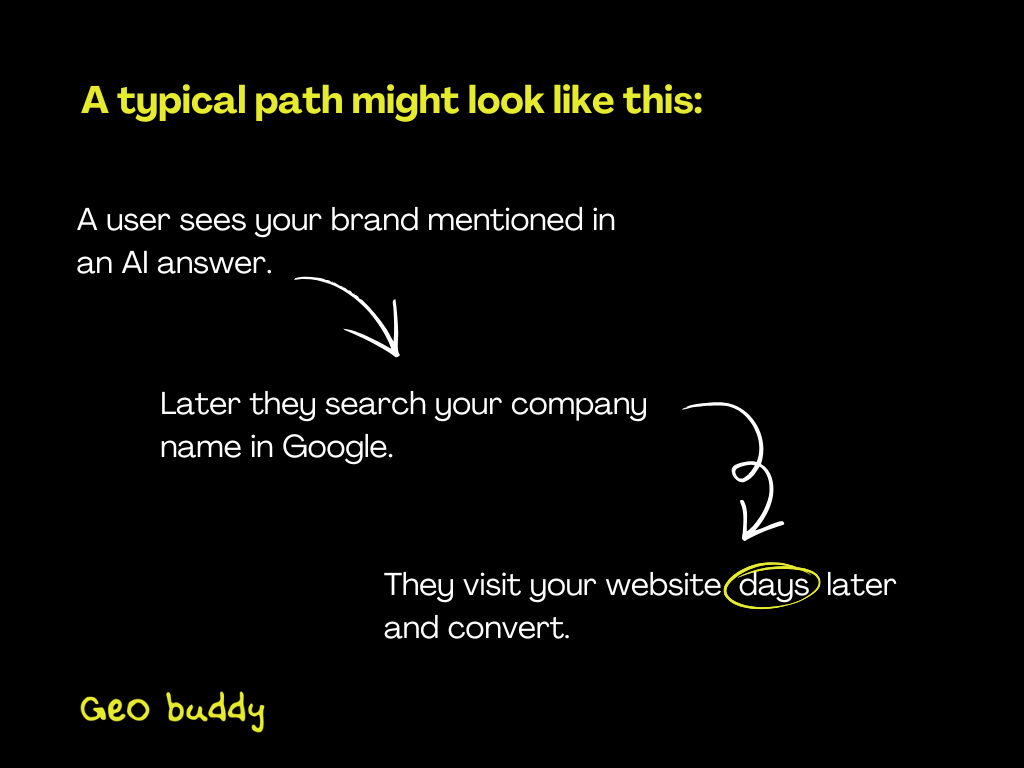
Most analytics tools credit only the last click, which means the influence of AI discovery often goes unmeasured.
One simple way to capture this signal is to include a question in your lead forms such as “How did you hear about us?” with options like AI assistant, ChatGPT, or recommendation.
How to capture AI-driven traffic
Companies that want to benefit from AI search visibility should focus on a few key areas.
First, create question-driven content. AI systems prioritize pages that directly answer real user questions, especially comparisons, use cases and limitations.
Second, structure content around complete topics rather than isolated keywords. AI systems retrieve information more easily when related pages cover a subject comprehensively.
Finally, ensure your brand positioning is clear and consistent across different sources. AI models often validate information using documentation, reviews, forums and other independent websites.
GeoBuddy insight
Across AI visibility audits conducted by GeoBuddy, one pattern appears repeatedly: companies invest heavily in SEO but overlook how their brand is described across the wider web.
As a result, AI tools sometimes cite secondary sources instead of the official website, or summarize the company in ways that don’t reflect its actual positioning.
Small structural improvements — clearer use-case pages, stronger FAQs, and more consistent messaging — can significantly increase how often a brand appears in AI answers.
The takeaway
The goal of modern search is no longer simply more traffic.
It is better traffic.
Visitors arriving from AI conversations typically come with clearer intent, more context, and a shorter path to decision. Companies that optimize for AI discovery are not just attracting visitors — they are attracting buyers who are ready to act.